
Character roster
Suikoden STAR LEAP Characters | Roster, Roles & Evaluation
Use the official character information as the starting point, then compare early roles, team fit, growth cost, and what is still unverified.

Short answer
Read the character name, relationship, role, and build cost together
When you search for Suikoden STAR LEAP characters, start with the KONAMI character introductions and relationship map. They establish names, story positions, and the way the cast is connected. Then use the live in-game profile and battle screens to check roles, skills, acquisition, and growth materials before deciding whether a character belongs in an early team. Official story information and combat performance are related, but they are not the same evidence.
This page uses the protagonist, Yua, Hou, Selen, Shapur, and other official entries as a readable starting point. It does not invent drop rates, fixed tiers, permanent rankings, or release-gated acquisition claims. Those details belong to a separately dated data page once the game and its regional information can be verified.
- Use the official relationship map to understand who is connected and where they fit in the story
- Judge an early best character by the missing role in your team, not rarity alone
- Compare team fit and growth cost before investing in several characters at once
- Use the separate gacha and reroll guides for summon and opening-account decisions
1. Official source
The official character relationship map is the roster's story-first entry point
The KONAMI character page groups the cast around the protagonist: village companions, people connected with trade and settlements, travel encounters, hostile groups, later liberation forces, and characters linked with Roadlake. That structure is more useful than a flat name dump because it helps a reader answer two different questions: who is this person, and when does this relationship matter? A character list should keep those questions visible.
The official map is also a source that can be checked again when a regional page, story chapter, or presentation changes. The table below is an editorial summary for navigation. It does not replace the current in-game recruitment rules, rarity, skills, or combat values.
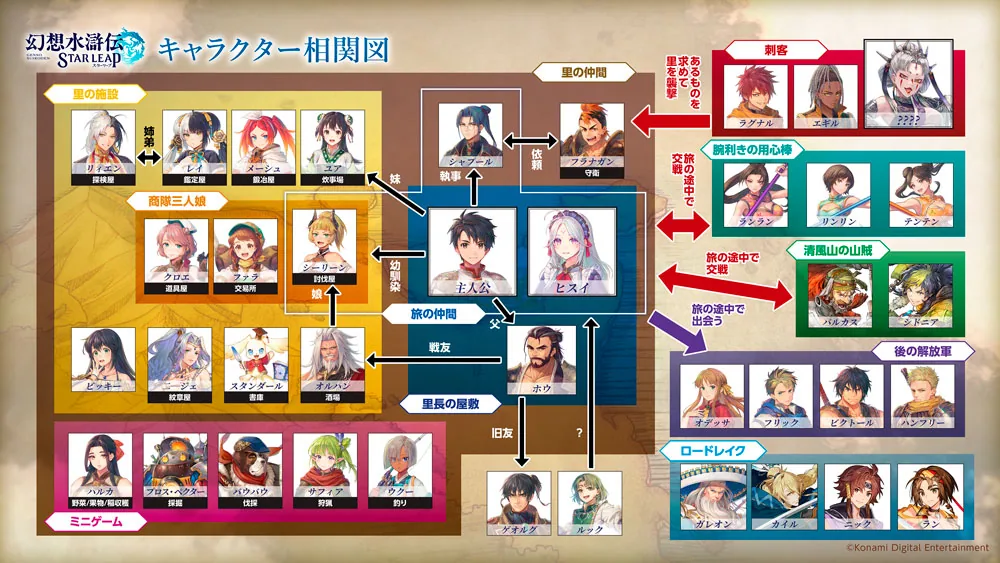
| Group | Examples or signal | How to read it |
|---|---|---|
| Protagonist and family | Protagonist, Yua, Hou | Start with the central story and close relationships |
| Village companions | Selen, Shapur | Connect early settlement context with allies |
| Trade and merchants | Chloe, Farah | Do not assume a story role equals a battle role |
| Travel companions | Vicky, Neaje | Check the official introduction and encounter context |
| Hostile or separate groups | Assassins and Qingfeng Mountain | Keep story position separate from acquisition claims |
| Liberation forces and Roadlake | Later story connections | Treat these as progression-linked context |
Story introductions and live combat data should be checked separately.
2. Protagonist and allies
Start with the protagonist, Yua, and the village circle when planning early goals
The protagonist is an obvious story and party anchor, but that does not mean every early resource should be pushed into one unit. Yua is important as the protagonist's sister, while Hou and Selen help establish the village and the relationships around it. Read their official descriptions for context, then use the in-game profile to determine how each character actually contributes to the team. A character roster is most useful when it turns names into decisions.
The same rule applies during a reroll or gacha decision. First identify the gap in the current team: healing, durability, area damage, support, action order, or a reliable main damage source. Once the missing role is clear, a character comparison can include the cost of building the unit instead of relying on a name or a single rarity label.

Protagonist
The story viewpoint and an early party anchor. Confirm the live role from the profile and battle screen.
Yua
The protagonist's sister. Keep story relationship and combat performance as separate fields.
Hou
The village chief and father. His official profile helps explain the settlement context.
Village circle
Selen, Shapur, and other allies help connect early story context with team planning.
3. Evaluation
A best-character answer needs role, team fit, and growth cost
Searches for Suikoden STAR LEAP best characters and tier lists are likely to change quickly after launch. New skills, gifts, enemy patterns, regional rules, and material availability can all change the value of a unit. Publishing a fixed ranking before those conditions are recorded creates a page that becomes misleading as soon as the game changes. A reusable evaluation method is safer and more useful at this stage.
Start with early-story stability. Then compare team fit, required materials, skill conditions, and whether another character can fill the same job. A compelling official character description is not evidence for an unlisted damage value or a guaranteed role. If a number cannot be checked in the target version, leave it unconfirmed.

-
1
Early stability
Can the unit help clear the tutorial and early story before a deep investment?
-
2
Missing role
Does the current team need damage, healing, durability, support, or area coverage?
-
3
Team fit
Check attributes, action order, skill conditions, and the way allies interact.
-
4
Growth cost
Compare equipment, experience, materials, and whether several units can be built together.
-
5
Replacement path
Ask whether the same role is easy to replace through a future gift or summon.
A published tier list should state its version, check date, conditions, and unknowns.
4. Early team
Use the roster to decide who to build next, not to build everyone at once
After reading a character list, diagnose the reason a stage stopped you. If enemies survive, look at a main damage role. If the team collapses, compare healing and durability. If units lose before acting, inspect action order or support. This approach turns the roster into a troubleshooting tool and prevents a new player from spreading scarce materials across too many characters.
An early team example should name jobs rather than promise a universal five-unit answer. Separate the main damage source, defensive layer, healing or support slot, and replacement option. That structure still works when a new character arrives, because the question remains the same: which role does the new unit improve, and at what cost?
| Early goal | Role to inspect | Decision note |
|---|---|---|
| Clear story safely | Main damage plus durability | Check survivability as well as damage |
| Remove groups quickly | Area damage plus support | Verify target count and skill conditions in-game |
| Keep allies alive | Healing plus defense | Compare timing, value, and resource cost |
| Save materials | Replaceable role | Build one main team before widening the roster |
The early goal is not to build every character; it is to fill the role blocking your next piece of progress.
5. Update policy
Keep unverified performance claims separate from official character facts
Official pages can verify names, relationships, voice actors, profiles, and other character-setting details. They do not automatically verify the current rarity, acquisition route, skill multiplier, growth materials, event schedule, or team ranking. Those fields can change with the game version or region. This page keeps confirmed facts and editorial evaluation rules separate so that missing data is not filled with guesses.
When individual character records become verifiable, the roster can branch into detail pages, material routes, and a dated tier list. The tier-list intent will remain separate from the character-list intent: the roster helps readers find people, while the ranking page explains conditions and comparisons.
Official profile
Use KONAMI for names, relationships, profile text, and other published character facts.
Live game data
Use the current in-game profile and notices for skills, acquisition, growth, and team fit.
Version record
If a number is published later, retain the target version and check date.
When a source and the live screen disagree, record the version and send the reader back to the source they can recheck.
FAQ
Frequently asked questions about Suikoden STAR LEAP characters
Where can I find the Suikoden STAR LEAP character list?
KONAMI's official character page is the primary place for published profiles and the relationship map. This guide reorganizes that information for early team and search decisions.
Are the protagonist or Yua the best characters?
An official story profile is not enough to prove combat strength. Check the current role, skills, growth cost, and fit with the team you actually have.
Is a character list the same as a tier list?
No. A roster answers who a character is and how the cast connects. A tier list compares performance under stated version and evaluation conditions.
How should I use the roster during a reroll?
Identify the missing early role first, then compare build cost and replacement options. Use the separate reroll guide for the opening-account decision.
What if the official profile and live game data differ?
Prioritize the target-version in-game display and official notices, record the check date, and avoid filling unverified numbers with assumptions.
Will individual character pages be added?
Yes, when official profiles, acquisition, roles, skills, and growth data can be checked well enough to support a useful record.
Official sources and related pages
Use the KONAMI pages for the published entity name, character profiles, and relationship map. Use the live game and current notices for acquisition and combat data.
- KONAMI official Suikoden STAR LEAP siteOfficial product information, notices, and distribution links.
- KONAMI official character pagePublished character profiles and the official relationship map.
Summary
Use the roster to explain a team decision, not just to memorize names
The safest Suikoden STAR LEAP character evaluation separates official profile facts from live combat data, then compares role, team fit, and growth cost. Keep fixed tiers and unverified numbers out of the roster until the version and evidence can be checked.